Choose your snack
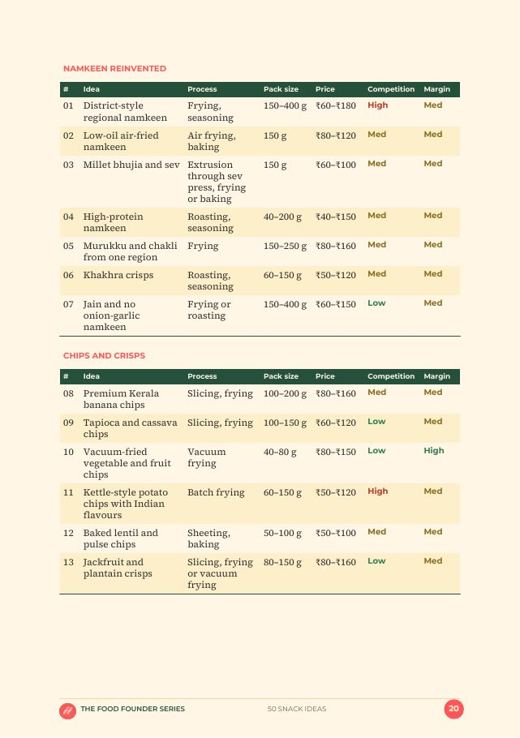
50 ideas in eight families, ten trends, the top 10 for beginners and a worksheet to pick your final three.
Sections 1 and 2
Ebook · The Food Founder Series
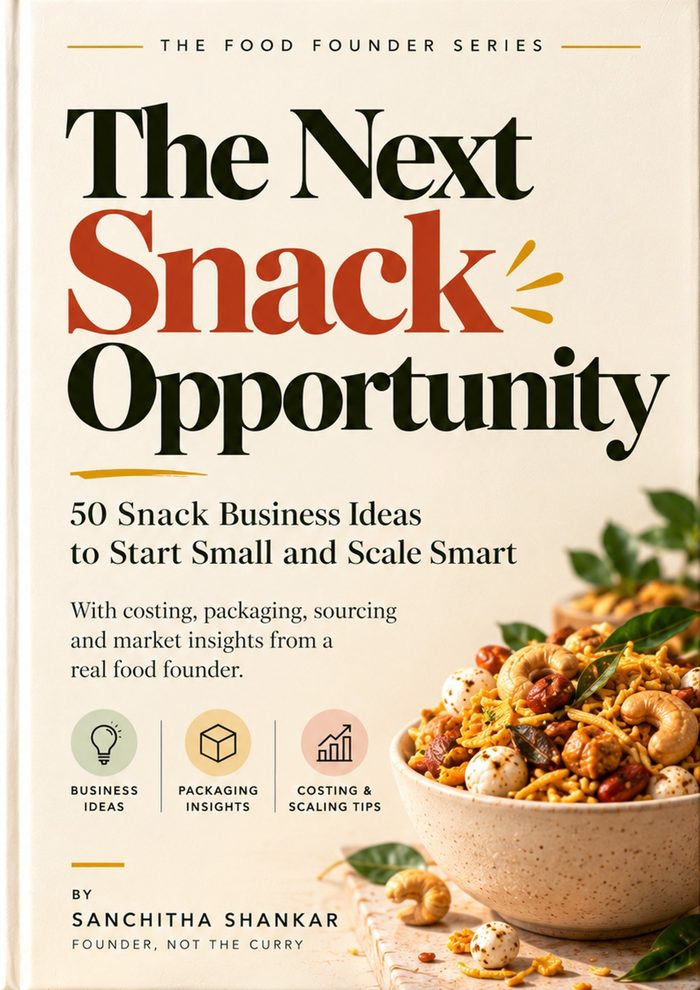
The Next Snack Opportunity shows you which snack to make, how to make and pack it, what to charge, and how to get your first 100 stores, with real costings in rupees.
By Sanchitha Shankar, founder of Not The Curry

 101 pages of diagrams, tables and checklists
Look inside
Real pages from the ebook. Scroll sideways or use the arrows.




Sound familiar?
Most first snack brands don’t fail on taste. They fail on the things nobody explains: picking a crowded shelf, ordering too much printed packaging, setting a price that leaves nothing after margins, and running out of cash while distributors take 30 days to pay.
This book walks you through each of those decisions before you spend money on them.
Guessing versus planning
| Without a plan | With this book |
|---|---|
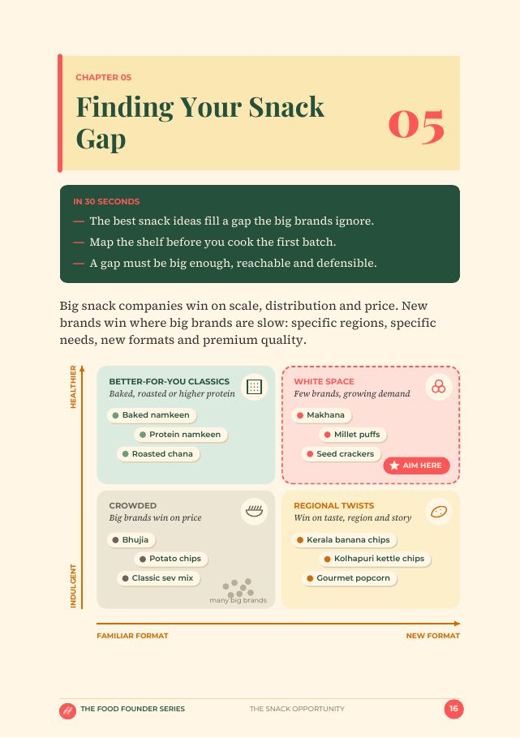
| Copy what is already on the shelf | Pick from 50 rated ideas and a shelf map of real gaps |
| Buy machines before you know what sells | Start with a co-packer or simple equipment, compared side by side |
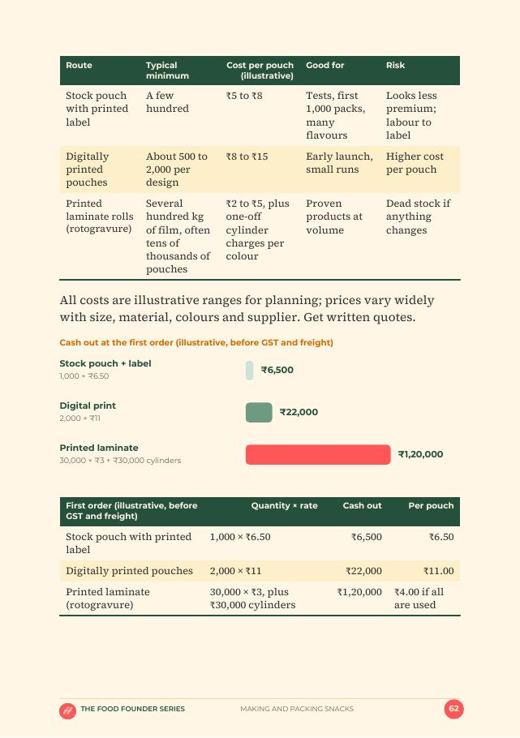
| Order 30,000 printed pouches to save money | Test with stock pouches or digital print, then print one hero flavour |
| Set MRP by copying a big brand | Work back from ₹10, ₹20, ₹60 price points and every trade margin |
| Count cost per pack and nothing else | Plan launch budget, working capital and monthly running costs |
| Hope stores reorder | Win your first 100 outlets on a weekly beat, and track each one |
What’s inside
The book follows the order you will actually work in. Every chapter opens with a 30-second summary and ends with three practical steps.
50 ideas in eight families, ten trends, the top 10 for beginners and a worksheet to pick your final three.
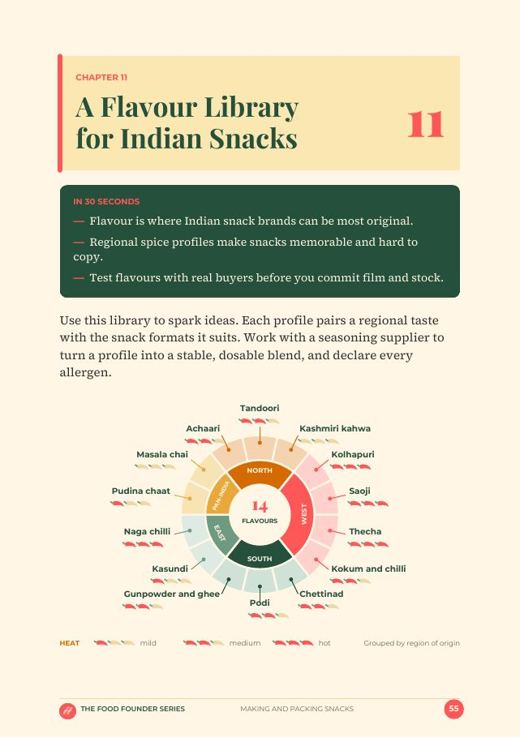
Sections 1 and 2Eight making methods, a recipe-to-product process, a sample specification and a flavour library of 14 regional profiles.
Chapters 8 to 11Shelf life, packaging that protects, a food-safety checklist and how to work with a co-packer.
Chapters 12 to 16Price points, trade margins and GST, with two snacks costed in full and three launch budgets from ₹50,000.
Chapters 17 to 20Choosing channels, winning your first 100 retail outlets, building a brand people pick up, and the licences and labels you need.
Chapters 21 to 24Signs you are ready to scale, a 90-day launch plan, templates, a glossary and clickable sources.
Chapters 25 to 30The book shows how one flavour change can turn 8,000 printed pouches into dead stock, and how to order packaging so it doesn’t happen to you.
An Excel workbook with 14 sheets and working formulas, attached inside the PDF and given as a separate download. Change the blue cells and every total updates.
| A | B | C | D | |
|---|---|---|---|---|
| 4 | LANDED COST PER PACK | ₹ | ||
| 5 | Base ingredients | 3.50 | ||
| 8 | Co-packer conversion | 7.00 | ||
| 9 | Printed pouch | 4.50 | ||
| 12 | Landed cost | 19.50 | ||
| 14 | CHANNELS (per pack) | General trade | Quick commerce | D2C |
| 15 | MRP (incl. GST) | 60.00 | 60.00 | 60.00 |
| 24 | Contribution per pack | 18.06 | 11.64 | 19.28 |
| 29 | Break-even packs, all general trade | 16,614 |
How the book thinks
Launch one product and one flavour that wins a blind taste test, then add more.
Buyers notice ₹10, ₹20 and ₹60. Fit grammage and margin to the price, not the other way round.
Sample, sell 100 packs, check shelf life, then commit money to film, stock and stores.
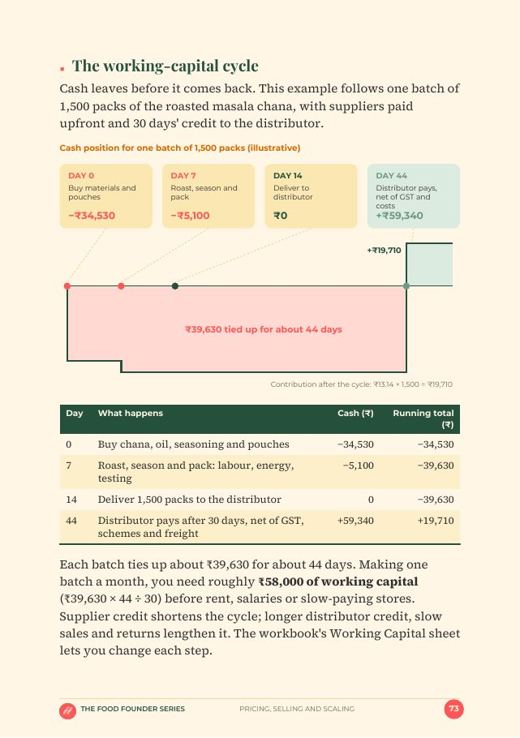
Know how long each batch ties up your money before you say yes to a big order.
Brands that show the way
Real snack brands, what they did, and what a first-time founder can learn from each.
reported valuation in its 2025 funding round, built on namkeen made consistently at scale.
reported FY24 revenue, by owning its home states before going national.
revenue in one year, FY24 to FY25, selling South Indian snacks online.
reported deal value when ITC took full ownership in 2026, after an online-first start.
Figures as reported in the press. Every source is linked in the book.
Read it anywhere
The PDF reads well on a phone, with a clickable contents page. Open the workbook on your laptop to cost your own snack.
Is it right for you?
Simple, one-time price
Pay once. Keep the PDF and the workbook, with free updates.
₹499 is about 1% of the smallest launch budget in the book (₹50,000), and far less than one wrong packaging order.
About the author
Founder of Not The Curry and author of The Food Founder Series. She writes the guides she wished she had when she started: practical, rupee-by-rupee, and honest about what can go wrong.
Questions
A 101-page PDF with a clickable contents page, plus the free Founder Tools Excel workbook. The workbook is also attached inside the PDF.
No. The book shows how to start with a co-packer, a manufacturer that makes your snack to your recipe, or with simple equipment in a small licensed unit, and how to compare the two.
The book sets out three illustrative budgets: ₹50,000 for a test market, ₹2 lakh for a small unit and ₹5 lakh for a co-packed launch, line by line.
It picks ten, such as high-protein namkeen, khakhra crisps, popped jowar and flavoured seeds, chosen for low capital, simple processes and lower shelf-life risk.
Yes. It covers FSSAI licences, labelling, net-quantity rules, the proposed front-of-pack warnings and GST on snacks, checked in October 2026. Always confirm with your accountant and FSSAI.
Yes. Replace the blue example cells with your own quotes and prices, and the costing, break-even and cash figures update.
₹499 is a launch offer. The regular price is ₹799.
Right after payment you see a download link, and the same link is emailed to you.
Your recipe is ready
Find your gap, make it crunchy, price it to pay and get it on the shelf, with the book and the free workbook.